The Hivites were one of the seven nations inhabiting the land of Canaan. They were descendants of Canaan, son of Ham. 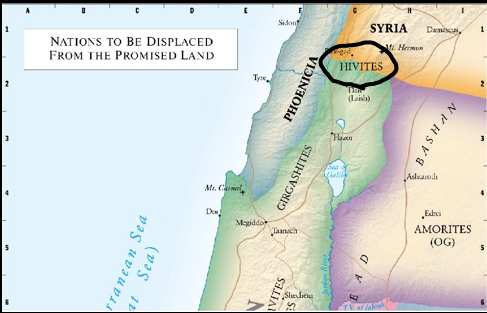
Genesis 10:15the Jebusites, the Amorites, the Girgashites,Genesis 10:16the Hivites, the Arkites, the Sinites,Genesis 10:17the Arvadites, the Zemarites, and the Hamathites. Afterward the families of the Canaanites were spread abroad.Genesis 10:18The border of the Canaanites was from Sidon—as you go toward Gerar—to Gaza—as you go toward Sodom, Gomorrah, Admah, and Zeboiim—to Lasha.
1 Chronicles 1:13the Jebusite, and the Amorite, the Girgashite,1 Chronicles 1:14the Hivite, the Arkite, the Sinite,1 Chronicles 1:15the Arvadite, the Zemarite, and the Hamathite.1 Chronicles 1:16The sons of Shem: Elam, Asshur, Arpachshad, Lud, Aram, Uz, Hul, Gether, and Meshech.
이들은 세겜 지역에 거주하였는데, 야곱(이삭의 아들)과 그 일족이 이 지역에 있다가 딸 디나가 겁탈을 당하게 되었고, 시므온(야곱의 아들)과 레위(야곱의 아들)이 그 지역의 남자들을 죽이고 약탈을 자행했다. 창세기 34장 참조
Exodus 3:8Now, behold, the cry of the children of Israel has come to me. Moreover I have seen the oppression with which the Egyptians oppress them.
Exodus 3:17They will listen to your voice. You shall come, you and the elders of Israel, to the king of Egypt, and you shall tell him, ‘Yahweh, the God of the Hebrews, has met with us. Now please let us go three days’ journey into the wilderness, that we may sacrifice to Yahweh, our God.’
Deuteronomy 7:1and when Yahweh your God delivers them up before you, and you strike them, then you shall utterly destroy them. You shall make no covenant with them, nor show mercy to them.
여호수아 시대에 이르러 히위 족속 중 기브온에 거주한 사람들은 이스라엘 민족과 함께하시는 하나님에 대하여 두려워하여 대항하기보다는 화친을 맺고자 계략을 꾸민다.
Joshua 9:3they also resorted to a ruse, and went and made as if they had been ambassadors, and took old sacks on their donkeys, and old, torn-up and bound up wine skins,Joshua 9:4and old and patched sandals on their feet, and wore old garments. All the bread of their food supply was dry and moldy.Joshua 9:5They went to Joshua at the camp at Gilgal, and said to him and to the men of Israel, “We have come from a far country. Now therefore make a covenant with us.”Joshua 9:6The men of Israel said to the Hivites, “What if you live among us? How could we make a covenant with you?”Joshua 9:7They said to Joshua, “We are your servants.” Joshua said to them, “Who are you? Where do you come from?”
또 이들 중 미스바 땅 헤르몬 산 쪽에 거주하던 히위 족속들은 하솔 왕 야빈과 함께 이스라엘 민족에 대항했다.
Joshua 11:1and to the kings who were on the north, in the hill country, in the Arabah south of Chinneroth, in the lowland, and in the heights of Dor on the west,Joshua 11:2to the Canaanite on the east and on the west, the Amorite, the Hittite, the Perizzite, the Jebusite in the hill country, and the Hivite under Hermon in the land of Mizpah.Joshua 11:3They went out, they and all their armies with them, many people, even as the sand that is on the seashore in multitude, with very many horses and chariots.
Joshua 11:19For it was of Yahweh to harden their hearts, to come against Israel in battle, that he might utterly destroy them, that they might have no favor, but that he might destroy them, as Yahweh commanded Moses.
Judges 3:1only that the generations of the children of Israel might know, to teach them war, at least those who knew nothing of it before:Judges 3:2the five lords of the Philistines, all the Canaanites, the Sidonians, and the Hivites who lived on Mount Lebanon, from Mount Baal Hermon to the entrance of Hamath.Judges 3:3They were left to test Israel by them, to know whether they would listen to Yahweh’s commandments, which he commanded their fathers by Moses.Judges 3:4The children of Israel lived among the Canaanites, the Hittites, the Amorites, the Perizzites, the Hivites, and the Jebusites.Judges 3:5They took their daughters to be their wives, and gave their own daughters to their sons and served their gods.Judges 3:6The children of Israel did that which was evil in Yahweh’s sight, and forgot Yahweh their God, and served the Baals and the Asheroth.
1 Kings 9:20their children who were left after them in the land, whom the children of Israel were not able utterly to destroy, of them Solomon raised a levy of bondservants to this day.1 Kings 9:21But of the children of Israel Solomon made no bondservants; but they were the men of war, his servants, his princes, his captains, and rulers of his chariots and of his horsemen.1 Kings 9:22These were the five hundred fifty chief officers who were over Solomon’s work, who ruled over the people who labored in the work.1 Kings 9:23But Pharaoh’s daughter came up out of David’s city to her house which Solomon) had built for her. Then he built Millo.
2 Chronicles 8:7of their children who were left after them in the land, whom the children of Israel didn’t consume, of them Solomon conscripted forced labor to this day.2 Chronicles 8:8But of the children of Israel, Solomon made no servants for his work; but they were men of war, and chief of his captains, and rulers of his chariots and of his horsemen.2 Chronicles 8:9These were the chief officers of king Solomon, even two-hundred fifty, who ruled over the people.2 Chronicles 8:10Solomon brought up Pharaoh’s daughter out of David)’s city to the house that he had built for her; for he said, “My wife shall not dwell in the house of David king of Israel, because the places where Yahweh’s ark has come are holy.”